screener-eval · five reps · the noise
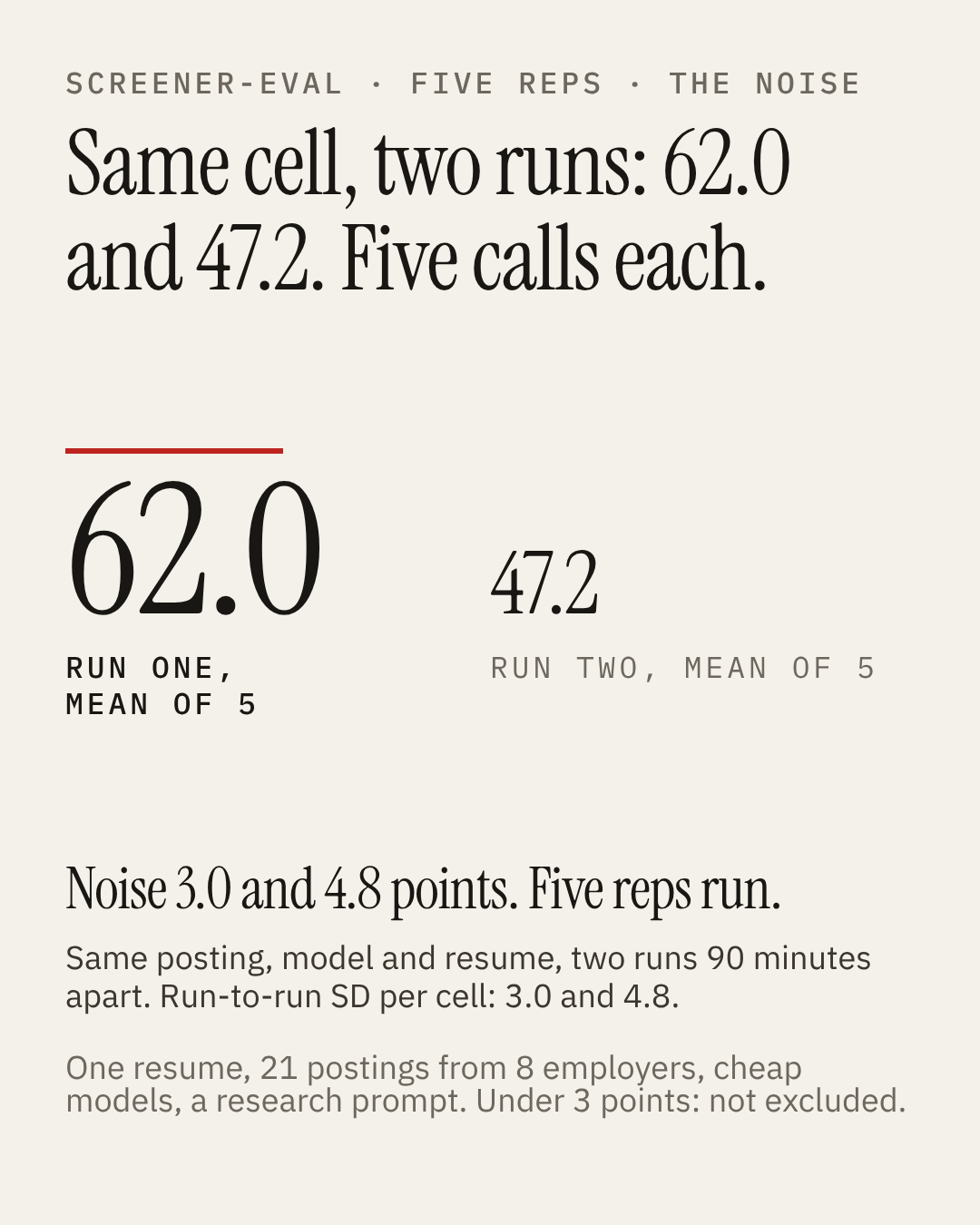
Same cell, two runs: 62.0 and 47.2. Five calls each.
The note
How many reps per cell did my screener study need? The pilot said 9 on claude-haiku-4-5 and 12 on gpt-5-mini to resolve a five-point effect. Every cell got five complete reps.
Same resume, same posting, same model, two separate runs about an hour and a half apart, on the same day: claude-haiku-4-5 gave the Meta machine learning PM posting a mean of 62.0 in one run and 47.2 in the other. Each mean is five calls.
That pair is the loud end: within its own run the cell ties for the noisiest on haiku, at a standard deviation of 11.0. The mean per-cell run-to-run standard deviation was 3.0 points on claude-haiku-4-5, median 2.4, and 4.8 on gpt-5-mini. On 17 of 42 posting-by-condition cells, haiku returned the identical score on every rep; gpt-5-mini did that on 0 of 42.
Every edit effect in the study carries a 95 percent interval, so the numbers look finished. Underneath, five reps leave those intervals wide, reaching to about minus three at the widest: minus 3.05 to plus 2.76, minus 3.03 to plus 0.84, minus 2.90 to plus 1.03, minus 1.82 to plus 2.71. The study's own sentence is that effects under about three points are not excluded. My reading of it: a two-point effect of deleting links could sit inside those intervals unseen.
Limits. One resume. 21 postings from 8 employers, treated as independent. Two cheap models in interleaved order. The twelve-rep figure comes from a pilot of ten reps on one posting, sized for a five-point effect, so it is an upper bound.
Would you publish a null edit effect from five reps, or hold it until the rep count matches what the pilot asked for?
Where the numbers live
- reports/RESULTS.md
- reports/cross_model_real-institution-swap.md
- reports/pilot_anthropic-pm-beneficial-deployments-001.md
- README.md
The case study, with the pilot and the noise figures
One resume, 21 postings from 8 employers, cheap models, a research prompt. Under 3 points: not excluded.